How to Fix a Google Penalty Caused by Backlinks-10 steps Guide
If your rankings dropped and you suspect backlinks, you are not alone. A lot of sites get into trouble because of old link building tactics, paid placements...

If your rankings dropped and you suspect backlinks, you are not alone. A lot of sites get into trouble because of old link building tactics, paid placements, or keyword-heavy anchors that looked fine years ago but now create risk.
The key is to stay calm and treat it like a cleanup project. First, you confirm the type of penalty. Then you remove and disavow the risky links in the right order. After that, you rebuild trust with safe SEO.
Step 1: Confirm what kind of penalty you have
Google issues two common kinds of hits.
A manual action is the obvious one. It appears inside Google Search Console under Manual actions, and you often get an email too. Search Engine Land explains that manual actions are applied by human reviewers and are shown in Search Console.
An algorithmic demotion is different. It does not show as a manual action. It usually looks like a traffic drop that lines up with updates or quality changes. Search Engine Land notes that recovery from algorithm updates can take 3 to 6 months or longer, depending on the situation.
Step 2: Stop the risky link building today
Before you clean anything, stop anything that can keep triggering the issue. Pause paid links, link exchanges, low-quality guest post campaigns, and anything that looks like a network.
If you keep building the same type of links during recovery, you are basically telling Google you did not really fix the problem.
Step 3: Export your backlinks from more than one place
Start with Google Search Console because it reflects Google’s own link data.
Then pull backlinks from a second tool so you do not miss patterns.
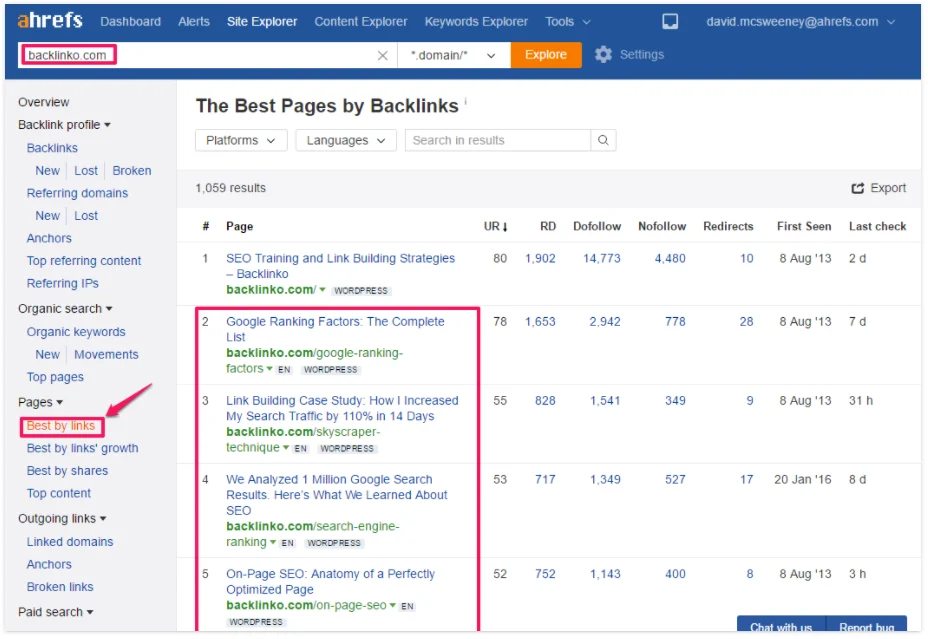
Put everything into one sheet and add columns like linking domain, linking page, target page, anchor text, notes, and a final decision field like keep, remove, disavow, or unsure.
Step 4: Find the patterns that usually cause backlink penalties
Backlink penalties usually come from links that look like they were built to manipulate rankings, not earned naturally. Google’s spam policies and Search Essentials are the baseline here, and violations can cause lower rankings or removal from results.
Look for these patterns:
- Too many exact match anchors that repeat the same money keywords
- Links from irrelevant websites that have no topic match with your site
- Sitewide footer or sidebar links that repeat across hundreds of pages
- Paid placements passing ranking value, especially on thin blogs or directories
- Sudden spikes of low-quality links in a short time
- Obvious network footprints like the same templates, same outbound links, same style content
Step 5: Decide what to remove vs what to disavow
Follow the official order. Google’s guidance is clear: first, try to get the bad links removed, and only then use the disavow tool if needed. It also warns that disavowal is advanced and can hurt performance if you do it wrong.
So you do it in two phases.
Phase one is link removals. You contact webmasters, ask politely, and keep proof of outreach. Even if only some links get removed, it helps because it shows effort.
Phase two is disavow. You disavow links you cannot remove, or links from sites that are clearly spam and have no chance of cleanup. This is most common when you have a manual action for unnatural links, or you strongly believe one is coming.
Step 6: Create the disavow file the correct way
Google has specific rules for disavow files:
It must be a text file, and the format must be correct. You can disavow a full domain by writing domain colon and the domain name, one entry per line. Google also allows comments with a hash sign. It has limits too, like 2MB max size and up to 100,000 lines.

A practical approach is this. If the whole domain is low quality, disavow the domain. If it is only one page and the rest of the site is fine, then disavow only that URL.
Step 7: If you have a manual action, submit a reconsideration request
Reconsideration requests are only for manual actions. If there is no manual action in Search Console, a reconsideration request will not help.
When you write your reconsideration request, keep it honest and specific. QuaidTech also highlights the need to identify the penalty type, fix the issue, and then submit reconsideration for manual actions.
Your request should include:
- What happened and why the links became unnatural
- What you did to remove links, with a summary of outreach
- What you disavowed and why
- What rules have put in place so it does not happen again
The goal is to show Google you understand the issue and you fixed it properly.
Step 8: If it is algorithmic, focus on trust rebuilding instead of paperwork
If there is no manual action, you still clean up the link profile the same way because risky links can hold you back. But the recovery is more about long-term trust signals.
After cleanup, improve the pages that matter most. Make your content more helpful, update thin pages, and improve internal linking so Google can understand which pages are most important. You also need to make your brand look real and consistent across the site, because many algorithmic hits are connected to overall site quality signals.
Keep your expectations realistic, too. Some sites bounce back quickly, but many recoveries take months, not days, especially after major algorithm shifts.
Step 9: A realistic recovery timeline
In the first week or two, your job is diagnosis and classification. Export links, identify patterns, and start removals.
In weeks two to four, you continue removals, prepare the disavow file, upload it if needed, and document every action properly. If you have a manual action, this is where you prepare and submit the reconsideration request.
After that, the next phase is stabilisation. Rankings may not jump instantly. If it is manual, you wait for the review. If it is algorithmic, you focus on improving quality and earning trust over time. Search Engine Land notes recoveries from algorithm updates can take 3 to 6 months or longer in some cases.
Step 10: How to prevent the same backlink penalty again
Prevention is mostly about rule-based link building.
You should avoid networks, avoid paid links that pass ranking value, and avoid forcing anchors. Your anchors should look natural, and your links should come from relevant websites where the placement makes sense for readers.
The safest approach is to build authority slowly with real mentions, editorial style placements, relevant niche sites, and content that deserves to be referenced. Google’s Search Essentials and spam policies are a good baseline for what not to do and what can create risk.
Also, do not wait for a penalty to run a link audit. Monthly or quarterly audits help you catch low-quality links early, before they become a big problem.
Need Backlink Penalty Recovery? Let RankViaLinks Handle It Safely
If your site got hit because of backlinks, the fastest way out is a clean audit, real removals, and a careful disavow, done the safe way. RankViaLinks can help you identify risky links, document cleanup properly, and rebuild authority with white hat link building that does not put your site at risk.
FAQs
1) Should I disavow all bad looking backlinks right away?
Not always. Google advises trying to remove links first and using disavow carefully because it can hurt if used incorrectly. Disavow is best when you have a manual action, or you are confident the links are a real risk.
2) How long does it take to recover from a Google penalty?
Manual actions depend on the review after your reconsideration request. Algorithmic drops can take longer, and some recoveries may take 3 to 6 months or longer, depending on the update and how much cleanup is needed.
3) Can one spammy SEO campaign still affect my site years later?
Yes, it can. Old paid links, keyword-heavy anchors, and network backlinks can remain in your link profile for a long time. That is why audits, removals, and careful disavowal work are important when the links clearly violate spam policies.
Conclusion
A Google penalty from backlinks is fixable, but it requires discipline. First, confirm whether it is manual or algorithmic. Then stop risky link building, audit your backlinks, and clean the profile using removals first and disavow only when truly needed, exactly the way Google recommends.
If you have a manual action, your reconsideration request should be transparent and supported by evidence. If it is algorithmic, focus on cleanup, plus long-term quality and trust rebuilding. Either way, the goal is the same. Remove the manipulation signals, rebuild credibility, and move forward with safe, relevant link building.
Recommended Articles:
Who Needs Link Building Services? A Practical Guide for Real Businesses
Why My Backlinks Are Not Indexed in Google – Ultimate Guide in 2026
Why Domain Authority Is Not Increasing and How to Fix It


